# 7.生命周期
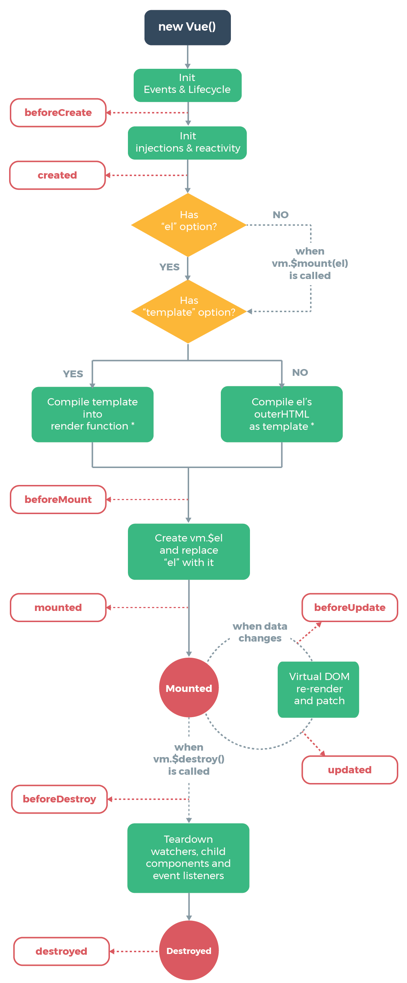
1.beforeCreate/created阶段$el不可见,mounted钩子在服务端渲染不执行。在beforeCreate/created中间主要做组件的初始化工作,如下:
// init.js
initLifecycle(vm)
initEvents(vm)
initRender(vm)
callHook(vm, 'beforeCreate')
initInjections(vm) // resolve injections before data/props
initState(vm)
initProvide(vm) // resolve provide after data/props
callHook(vm, 'created')
其中initState的顺序依次是props,methods,data,computed,watch:
export function initState (vm: Component) {
  vm._watchers = []
  const opts = vm.$options
  if (opts.props) initProps(vm, opts.props)
  if (opts.methods) initMethods(vm, opts.methods)
  if (opts.data) {
    initData(vm)
  } else {
    observe(vm._data = {}, true /* asRootData */)
  }
  if (opts.computed) initComputed(vm, opts.computed)
  if (opts.watch && opts.watch !== nativeWatch) {
    initWatch(vm, opts.watch)
  }
}
2.beforeMount之前判断是否有template,有template按template编译,没有template按el绑定作为模板
3.beforeMount之后mounted之前编译的内容替换el的dom,如果没有el,beforeMount、mounted钩子不执行,所以$el不可访问,可以手动调用$mount()方法使得$el可访问。
4.render function接受三个参数:第一个要创建的标签,第二个为Vue的options,它是一个对象,如{props,data,methods},第三个为这个标签内的内容。如果这些内容为标签,则第三个参数为数组。
5.render执行在beforeMount和mounted的中间。
6.render函数中使用JSX,v-if 在 render 中 用原生if/else,v-for 在 render 中用原生map,v-model 在 render 中value 、input 事件实现,类似v-model 的值直接保存到 vuex 中的实现方法。
7.在render中引用其他组件,如果是大写开头引入的可以不注册,所以推荐引入组件的时候都大写开头,同时它也是一个类,更符合类的写法。
在组件的option中设置functional:true(或者在template模板组件中写在script标签内部),使组件无状态 (无 data ) 和无实例 (无 this 上下文)。返回虚拟节点使他们更容易渲染,但是render函数会提供第二个参数context以访问上下文。
render(h){
  return h('div',{},['this is message'])
},
renderError(h,err){
  return h('div',{},err.stack)
}
8.beforeCreate/beforeDestroy 在element-ui的steps步骤条中使用。
- 生命周期钩子执行顺序:
mixin->componentSelf->extend
mehthod覆盖原则:extend覆盖componentSelf覆盖mixin
10.父组件监听子组件的生命周期
高级技巧
<child @hook:mounted>